
How can agricultural research effectively support the transition to climate-neutral farming? This question lies at the heart of the Climate Smart Research project, which brings together Experimental Research Stations across Europe to test and develop climate-smart farming solutions.
To guide this work, the project has developed a Conceptual and Analytical Framework for Climate Smart Agriculture Research (Deliverable D1.1), which helps structure how climate-smart agriculture is understood, studied and applied within the project.
What does “climate-smart agriculture” actually mean?
Climate Smart Agriculture integrates the three dimensions of sustainable development – economic, social and environmental, and is often described through three main goals¹:
- Sustainably increasing agricultural productivity and incomes,
- Adapting and building resilience to climate change, and
- Reducing or removing greenhouse gas (GHG) emissions where possible.
In practice, however, these goals are not always perfectly aligned. A farming practice that improves productivity may increase emissions, while a mitigation strategy may affect yields or require changes in farm management. Understanding these trade-offs and potential synergies is therefore a key challenge for both researchers and farmers.
The CSR framework helps address this complexity by providing a structured way to analyse climate-smart practices, understanding the complexity, interdependence and interactions of a farming system as a whole.
Conceptual and Analytical Framework
Contemporary research on Climate Smart Agriculture tends to focus on individual solutions, missing a holistic whole-farm perspective that includes pedoclimatic context, interactions, synergies and trade-offs. To address this gap, the CSR project has developed a conceptual framework for conducting climate-smart agricultural research, aiming to maximise the impact of research activities. The aim of this framework is to 1) introduce, clarify and align key concepts for conducting climate-smart agricultural research; and 2) ensure alignment of methods, data and impact, as well as creating a common language within the CSR project.
The framework consists of two parts: a conceptual framework and a research framework.
The conceptual framework describes what we know about Climate Smart Agriculture and doing Climate Smart Agriculture research, identifying and defining key concepts. The research framework describes where we go with this by defining research questions around the core concepts.
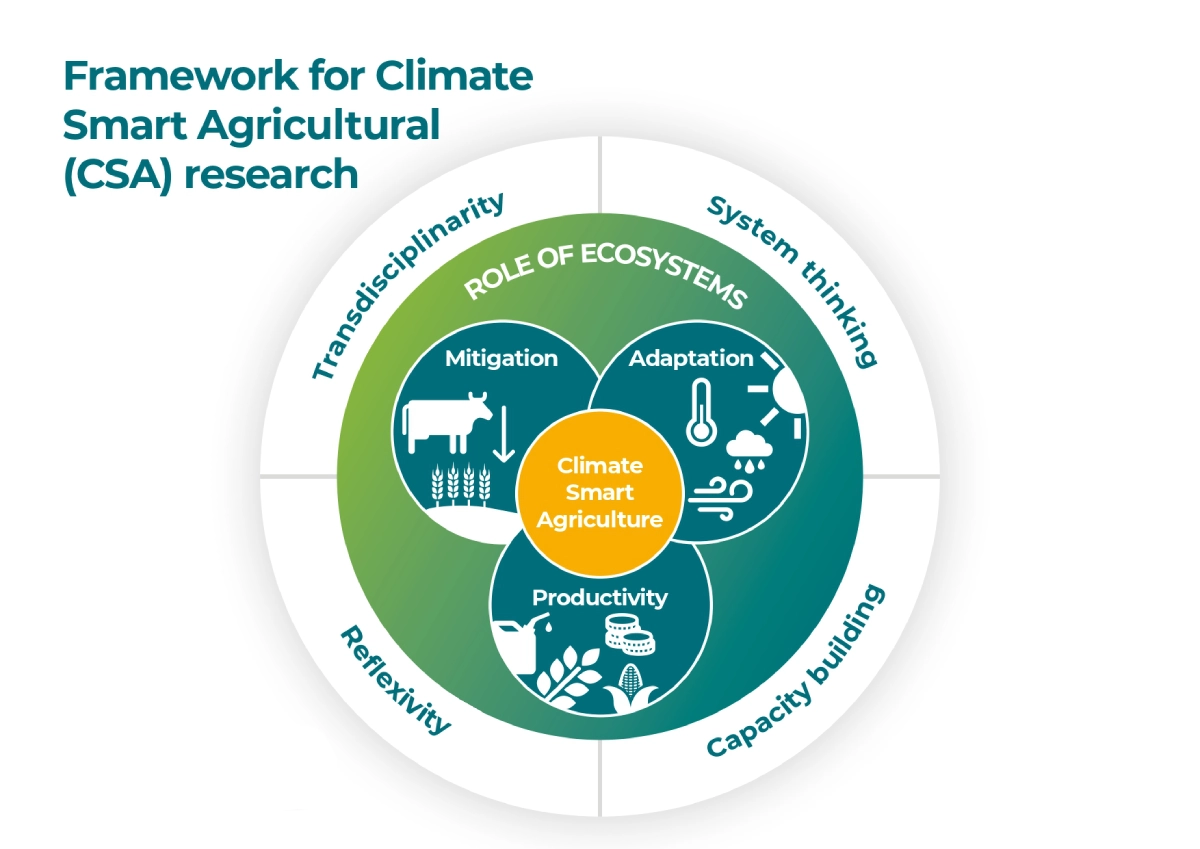
The Conceptual Framework describes six core concepts for Climate Smart Agricultural research:
- Climate Smart Agriculture in ‘real conditions’ (Mitigation, Adaptation, Productivity)
- Role of ecosystems supported and/or impacted by Climate Smart Agriculture
- System thinking
- Capacity building
- Reflexivity
- Transdisciplinarity
The Research Framework explores four main topics:
- Defining Climate Smart Farming practices and measuring success;
- What Climate Smart practices work and why?
- Enabling the transition to climate neutral agriculture by farmers;
- Building capacity for Climate Smart Agriculture research.
Building a common language for climate-smart research
The Climate Smart Research project aims to accelerate the transition to climate neutral agriculture and contribute to EU climate goals by developing new Climate Smart Agriculture knowledge and innovations, connecting 29 agricultural Experimental Research Stations (ERS) operating in different countries, farming systems and pedo-climatic conditions.
By defining key concepts, terminology and analytical approaches, the framework helps ensure that all partners within the project are working with the same definitions and research logic.
This shared conceptual basis will support collaboration among research stations and allow results to be compared, integrated and interpreted more effectively across different pedo-climatic zones and farming systems.
To learn more about the conceptual and research framework, explore the full deliverable introducing the key concepts of climate-smart agriculture research, explaining how these concepts will be operationalised in CSR, and outlining the research questions guiding CSR research activities that support the transition to climate-neutral farming in Europe.
¹This definition is from the FAO, we can include this reference: FAO (2013). Climate-Smart Agriculture Sourcebook Executive Summary. Food and Agriculture Organization of the United Nations