
How can agriculture significantly reduce greenhouse gas emissions while remaining productive, resilient, and economically viable?
This is the challenge at the heart of the Climate Smart Research (CSR) project. Ten Pioneering Experimental Research Stations (PioneERS) across Europe (including one in New Zealand), have now developed their first Climate Action Plans (ClimAPs), setting out ambitious pathways toward climate-smart farming systems capable of reducing GHG emissions by at least 55% – and in some cases moving towards climate neutrality.
The newly published analysis of the first ClimAPs provides an overview of how different agricultural research systems are tackling climate change under real farming conditions.
What are the PioneERS?
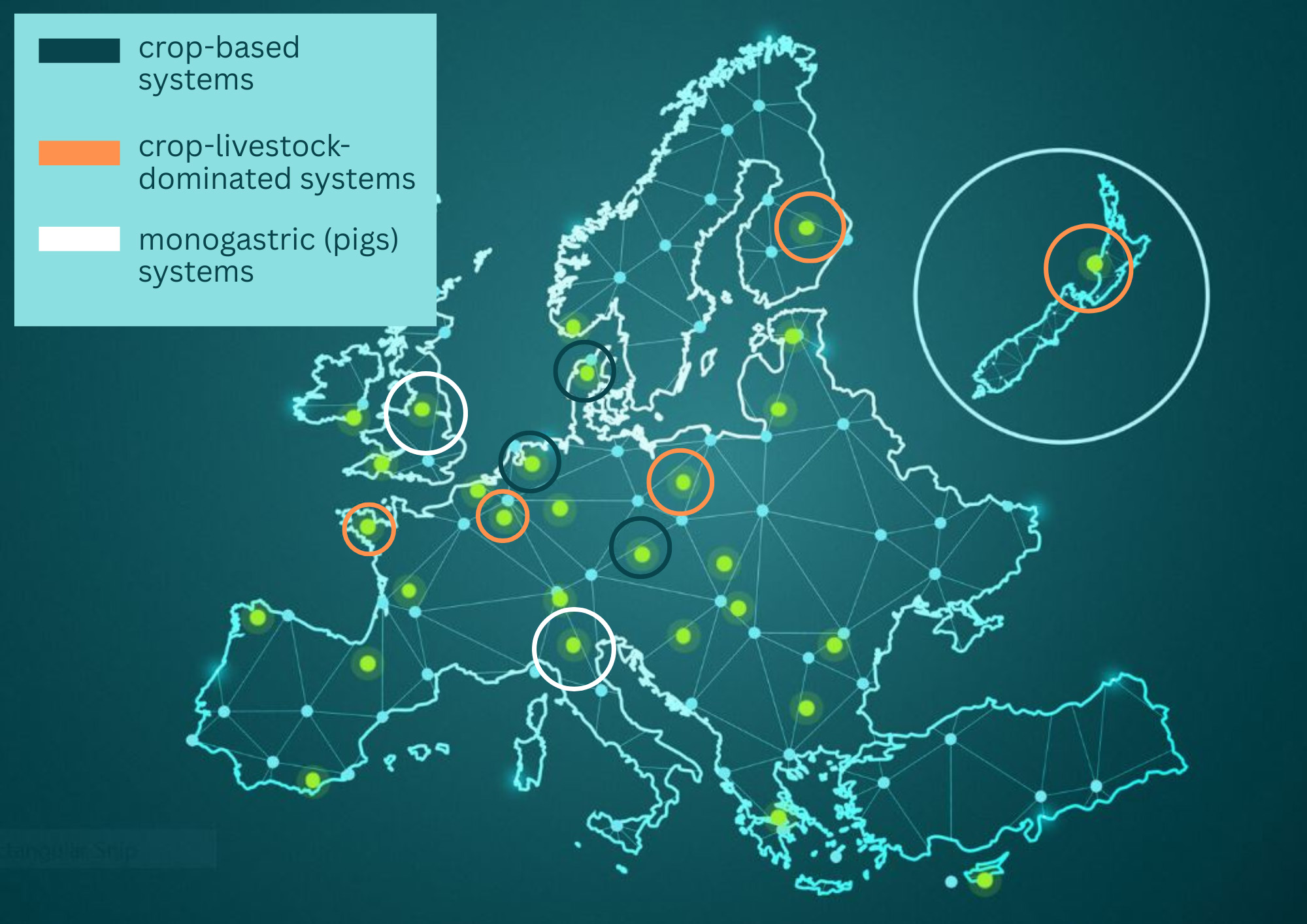
The PioneERS are ten pioneering agricultural research stations established within the Climate Smart Research project, located across contrasting pedo-climatic zones – in the Czech Republic, Poland, the UK, the Netherlands, Finland, Denmark, Italy, France, Belgium, and New Zealand. Representing a diverse range of farming systems and environmental conditions, they form a living network where innovative climate-smart solutions are scientifically tested, evaluated, and improved to stimulate adoption across the agricultural sector.
Spanning crop-based, crop-livestock, livestock, and monogastric farming systems, the PioneERS are designed to test and validate climate-smart solutions in real-world conditions, ensuring that research is relevant and applicable to commercial farming.
The consolidated analysis of the general characteristics of the PioneERS showcases the clear differentiation between system types, with three dominant categories: (i) crop-based systems (Czechia, Netherlands, Denmark), (ii) crop-livestock-dominated systems (France, Belgium, Finland, Poland, New Zealand), and monogastric (pigs) systems (Italy, UK). These system types are associated with distinct emission profiles and mitigation opportunities.
Climate Action Plans: A Roadmap for Transformation
Each PioneERS has developed a Climate Action Plan (ClimAP) which maps current and future research activities focused on supporting the transition towards climate-neutral and climate-resilient agriculture.
One of the strongest messages emerging from the analysis is the focus on integrated, whole-farm approaches. Instead of treating emissions, productivity, biodiversity, and resilience as separate challenges, the PioneERS are exploring how these elements interact within complex farming systems. The goal is not simply to reduce emissions, but to redesign farming systems that can remain productive while adapting to climate change and increasing extreme weather events.
Across the PioneERS, different farming systems come with distinct emission profiles and mitigation opportunities. Livestock systems mainly focus on reducing enteric methane, while arable systems aim to reduce nitrogen losses and energy use. Mixed systems, in turn, open the door to circularity, but also bring added complexity in managing trade-offs.
The analysis also reveals a consistency in agricultural GHG emissions across countries, despite differences in farming systems. Enteric methane (CH₄), soil nitrous oxide (N₂O), and carbon dioxide (CO₂) from inputs and energy use are identified as the dominant emission sources in all stations. This convergence points to a clear message: while solutions may differ locally, effective mitigation ultimately targets a small set of core emission processes.
Another finding is related to the role of pedoclimatic conditions. The conclusion is that pedoclimatic conditions are a key determinant of both emission dynamics and the feasibility of mitigation measures, especially in extreme environments. From boreal peatlands in Finland and high-rainfall systems in Belgium and France to reclaimed clay soils in the Dutch polders, environmental and farming contexts are key drivers in identifying suitable solutions to combat climate change.
The importance of farmers and stakeholder co-creation
An important feature of the CSR approach is the close involvement of farmers and stakeholders in the development of the ClimAPs. Across the PioneERS, research questions and innovations are being co-constructed together with practitioners to ensure practical relevance, feasibility and scalability.
This participatory process enables farmers to actively contribute to shaping the solutions tested at the Experimental Research Stations while also helping researchers better understand operational challenges, adoption barriers and real-world farming priorities.
Three Major Transformation Pathways
Although each PioneERS addresses mostly local or regional challenges, the compilation and summary of research questions across the stations shows three core common transformation pathways:
1. Optimising carbon and nitrogen cycles
Across all ten PioneERS, nitrogen management has emerged as a key priority, reflecting its crucial role in balancing agricultural productivity with climate ambitions. Nitrogen is both a key driver of farm productivity and a major source of nitrous oxide emissions, making it central to the transition toward climate-smart agriculture.
Researchers are tackling the issue from multiple angles: improving nitrogen use efficiency in the Netherlands and New Zealand, optimizing fertilizer application in Finland and Denmark, and harnessing the power of legumes to naturally enrich soils in Finland, Denmark, and Belgium.
In Denmark, the impact of adding grain legumes such as faba beans to crop rotations is being evaluated in terms of soil organic carbon dynamics, reduced use of mineral fertiliser, and integration into animal diets.
In New Zealand PioneERS, research on nitrogen cycle is covering all the steps: fertiliser type, rate, and application strategy, and use of low-N supplementary feed to meet cow requirements. Any reductions in nitrogen input will be incorporated into the life cycle analysis conducted each year of the project to evaluate effects on whole-farm emissions.
Together, these efforts show a need for smarter nutrient management systems – combining biological solutions, such as legume integration, with precision farming approaches powered by data and technology.
2. Reducing livestock methane emissions
Methane emission mitigation has emerged as a major research focus across livestock, dairy, beef, and mixed farming systems in France, Finland, New Zealand, Poland and Belgium. Researchers are exploring a range of complementary approaches, including feed innovations, genetic selection, and broader system-level management changes, reflecting the understanding that significant methane reductions cannot be achieved through a single solution alone. In France for example, the PioneERS is experimenting a whole cocktail of solutions with the added impact is the real innovative character of the climate action plan towards a very low GHG emissions system : use of low emission factor feeds, feed additives, optimization of forage quality, reduction of non-productive animals and improved herd management.
The Polish PioneERS investigates the partial replacement of soybean with locally available rapeseed products (oil cake or meal) with an effect on emission from the feed production but also from the changes in enteric fermentation. Emissions will then be assessed in dairy cows using respiration chambers, allowing precise quantification of greenhouse gas emissions and evaluation of the effectiveness of the feeding strategy.
Research conducted across the PioneERS highlights that progress will depend on combining multiple strategies at the animal, feed, and farm-system levels. Among these, feed additives stand out as both a promising opportunity and a potential challenge, with their adoption likely to depend on farmer uptake and consumer acceptance of those solutions.
3. Systemic redesign of production systems
Rather than focusing on isolated practices, several PioneERS are exploring systemic-level experimentation and redesign. Belgium’s whole-system agroecological approach, Denmark’s innovations in crop rotations, and the UK’s integration of manure management, energy use, and feed systems all point in this direction.
The Belgium experimental station will substitute suckler herd beef production by fattening of crossbred calves from dairy herds and crops production. This beef production will be mainly based on grass, reducing the carbon footprint of beef production by valorizing dairy-origin animals and limiting external inputs. This mixed crop–livestock system also enhances resilience to climatic variability (drought and excess water) through diversification of production and resource flows.
This implementation of systemic thinking reflects a growing recognition that the largest potential for achieving positive climate impact lies in optimising entire farming systems rather than individual components, which is essential for identifying and managing key trade-offs, such as those between productivity and emissions, or between different emission sources.
No Single Fix: A Portfolio of Solutions for Climate-Smart Farming
The analysis of the ClimAPs showcases the cutting-edge nature of the implemented solutions. The innovative character is linked to the testing of new solutions, combining existing solutions that have never been tested together at farm level, or redesigning entire farming systems.
At the same time, the analysis reveals important barriers: economic uncertainty, high investment costs, and persistent adoption challenges linked to labour, knowledge, and risk perception. These aspects make stakeholder engagement and enabling mechanisms a critical step in moving solutions from trials to practice by farmers.
Overall, the ClimAPs confirm that there is no single fix – climate-smart agriculture relies on a portfolio of complementary, context-specific solutions built on efficiency, circularity, and resilience.
The next step for the 10 PioneERS is now to implement these solutions on farm, set up a multi year plan of measurement with a solid scientific common framework and produce every year a life cycle analysis (LCA) evaluation of the whole low carbon system regarding GHG emission. This LCA assessment will be completed by other approaches to quantify effects on adaptation to climate change, biodiversity, water quality, and soil carbon sequestration changes.
The CSR PioneERS network will be able to produce a list of cutting edge systemic solutions, with guidance on how to implement them at a systemic level. This will increase understanding across European agriculture of how to transition to climate-smart food production while maintaining a focus on the synergies and trade-offs between net carbon emissions, productivity, climate resilience, competitiveness, and the ecosystem services of European farms.
The comprehensive analysis is presented in CSR Milestone 3.2, First ClimAP PioneERS – ClimAP Summary and Analysis. Explore the key insights and access the full document here.